
For decades, many of the great teachers in the personal development world have reminded us that lasting success is about far more than simply knowing what to do. Bob Proctor often suggested that the vast majority of our results are determined not by mechanics, but by mindset. Tony Robbins has expressed a similar truth in different language, arguing that our psychology shapes far more of our success than strategy alone. I believe there is profound wisdom in that.
And yet, through my own journey and many years of walking alongside clients, I have found myself wondering whether there is another layer still. Mindset undoubtedly matters. But what shapes our mindset? What influences the opportunities we notice, the strategies we choose and the actions we ultimately take? Why do two people, equipped with similar knowledge, similar opportunities and even similar strategies, create completely different experiences of success?
If success were simply a matter of finding the right strategy, surely many more of us would already be living the lives we dream of. Never before have we had such easy access to knowledge. Books, courses, podcasts and experts have made almost every strategy imaginable available to us for every sphere of life. There is no shortage of frameworks, models and step-by-step plans to help us move towards our goals. And yet, people following remarkably similar strategies often create profoundly different experiences of success. That has led me to wonder whether strategy, while essential, is not the source of transformation at all?
Over time, I have come to see strategy rather differently. I no longer believe strategy creates transformation; rather, I believe it amplifies it. In fact, I would go a step further. The opportunities we recognise, the strategies we choose and the actions we take are all amplifiers. None of them creates transformation in its own right. Instead, they amplify the place from which they arise. Let me explain.

Imagine two people walking into exactly the same meeting. They are presented with the same opportunity. One walks in quietly wondering, “How do I prove myself?” The other is asking, “How can I make the greatest contribution here?” The opportunity itself has not changed. What has changed is the place from which each person meets it—and therefore what it amplifies. One leaves feeling judged, anxious and depleted; the other leaves energised, connected and clear.
The same is true of strategy. One person develops a strategy designed to prove themselves, another develops a strategy designed to serve. Outwardly the plans may look remarkably similar, yet inwardly they arise from entirely different places. Eventually both people take action. Again, the behaviour may appear almost identical, but over time each action amplifies the place from which it arose.
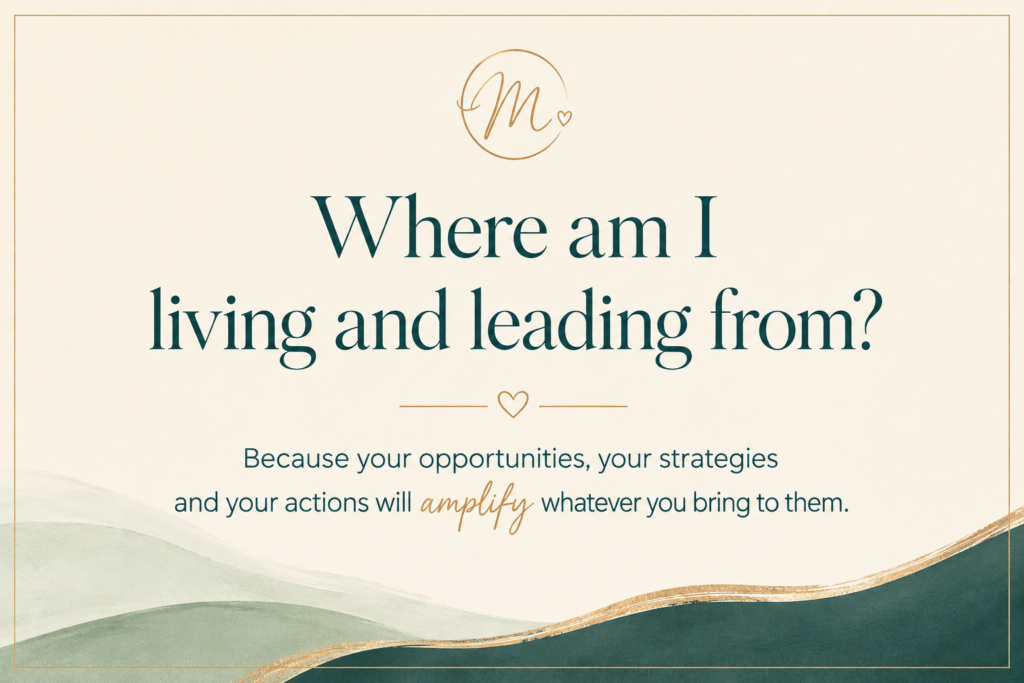
This is the pattern I have found myself observing again and again. Opportunity, strategy and action do not create transformation on their own. They amplify where we are living and leading from.
I have seen this many times with clients preparing for promotion or interviews for higher level roles. Often they come to me after having been unsuccessful in previous rounds. Their instinct is understandable. They assume they need a better strategy: a stronger application, better interview techniques, better answers and more evidence of their capability.
There is, of course, real value in preparing well and in demonstrating how you contribute to an organisation’s goals. Strategy matters. But something much more significant usually happens during our work together.
Instead of asking, “What do they want from me?” we begin asking, “What contribution do I want to make if I were entrusted with this role?” We reconnect with what matters most: the values they want to embody, the difference they long to make, the kind of leader they want to be and the legacy they hope to leave. As those questions deepen, something shifts. People stop trying to manufacture a version of themselves they hope will succeed and begin expressing the person they know themselves to be at their best.

Interestingly, the strategy changes too. Not because they have learnt a clever new technique, but because they are no longer trying to become someone else in order to succeed. Their applications become clearer because they are clearer. Their priorities become simpler because they are no longer trying to please everyone. Their interviews become more compelling because they speak from conviction rather than performance.
Many go on to achieve promotion or interview success in the very next round. Yet what stays with me most is not that success itself, but what they tell me afterwards. Work feels easier. They enjoy it more. They feel more authentic. The constant pressure to be all things to all people begins to dissolve.
The promotion matters, but the deeper transformation happened long before the successful application or interview. It happened when they changed where they were living and leading from.
Opportunity, strategy and action don’t create transformation.
They amplify where we are living and leading from.
This is why I so often say that transformation is an inside-out job. Finding your way back IN has never been about becoming less ambitious. It has never been about rejecting opportunity, strategy or action. Quite the opposite. They all matter deeply. But before we ask the mind to assess the opportunity, build the strategy and execute it, we first need to reconnect with the place from which the best of that can emerge.
✨ In my experience, something profound begins to shift when we stop asking the mind to tell us who we should become and what we should do and instead allow the heart to reconnect us with who we already are. From that place, the mind has an entirely different role. Rather than searching outside ourselves for our worth, it becomes wonderfully strategic in expressing it. The mind is no longer trying to tell us who to be; it is helping us express who we already know ourselves to be.

Over the years I have noticed that, when this shift happens, the questions themselves begin to change.
Instead of asking, “How do I prove myself?” we begin asking, “What is mine to contribute?”
Instead of asking, “How do I become enough?” we begin asking, “How can I express more fully who I already am?”
Instead of asking, “What will make me look successful?” we begin asking, “What allows me to live and lead with integrity?”
These are not simply more positive questions. The questions themselves, and the answers they open up, arise from a different place altogether. And because they arise from a different place, they lead us towards different opportunities, different strategies and different actions, ones that are far more likely to lead to success with integrity intact.
Observing this over many years has led me to believe that the quality of what we create in the world can never be separated from where we are living and leading from.
So before asking what opportunity to pursue, what strategy to adopt or what action to take, ask yourself one simple question:
Where am I living and leading from?
Pause and breathe. Come back to yourself. Remember what matters most. Reconnect with the contribution only you can make. Allow your heart to remind you who you are and what matters most and only then let your mind build the strategy that best serves what you’d love to create.